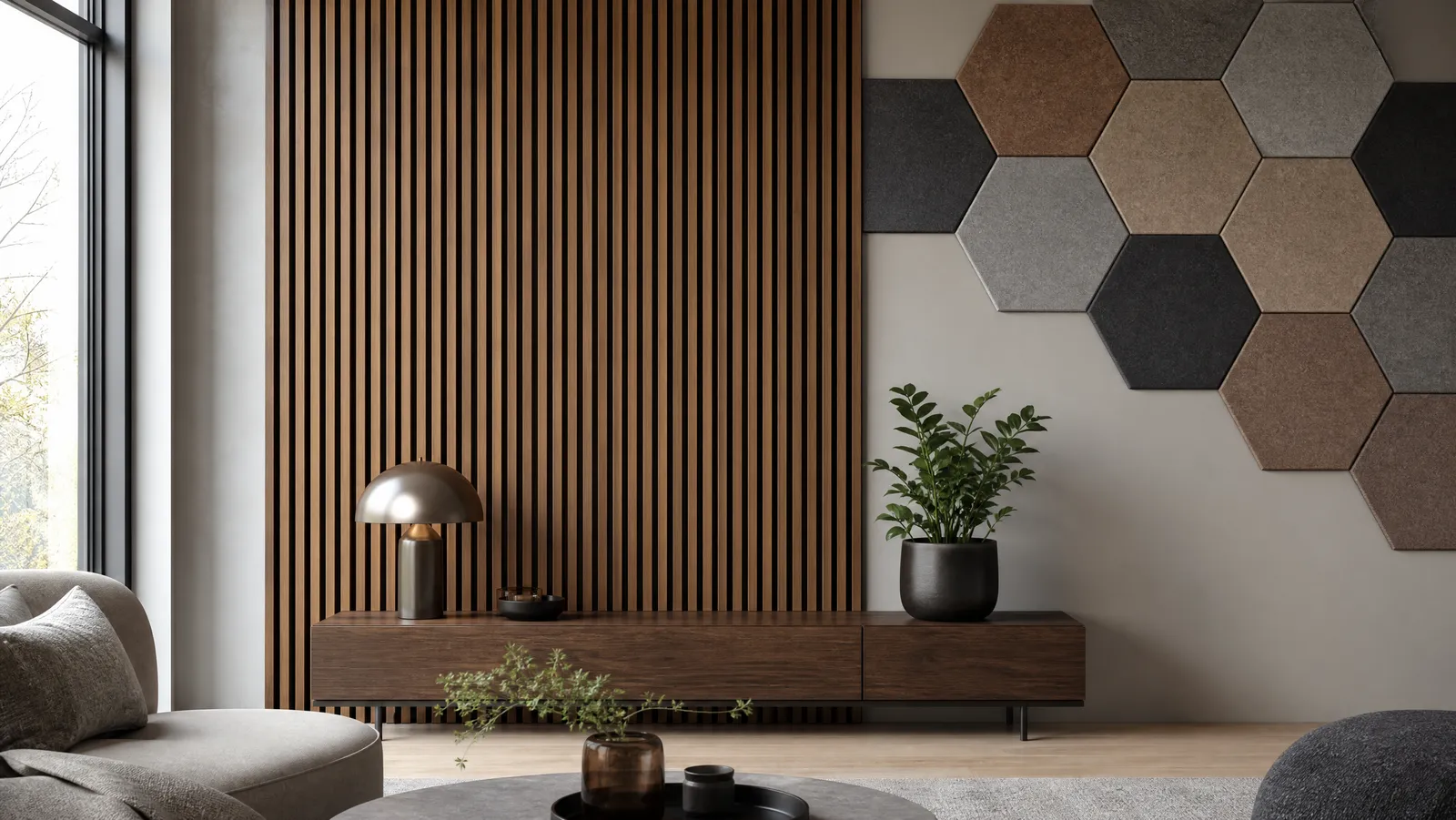
Yes, decorative acoustic panels can look genuinely good — warm walnut slats, colored felt hexagons, matte-black fluting that reads as architecture instead of a recording booth. If you want panels you would actually be happy to see on the wall, this guide picks four of them by style rather than by spec sheet. One honest caveat comes first.
Here is the caveat, because it is the whole reason to trust the rest of this page: every panel below absorbs sound inside your room. That cuts echo, flutter, and the hollow ring of a hard-floored apartment. None of them blocks a noisy neighbor. If the sound you hate is coming through the wall, panels are the wrong tool, and what you actually want is how to soundproof apartment walls with added mass and airtight seals. Keep that split straight and these picks make sense; ignore it and you will waste money on the wrong problem.
What Decorative Acoustic Panels Actually Do (Absorb, Not Block)
Decorative acoustic panels absorb echo inside the room you hang them in. They do not stop sound from passing through a wall in either direction. That single distinction is the most important thing to understand before you buy, so it is worth pinning down with the actual measurements.
There are two ratings you will see thrown around, and they are not interchangeable. According to Acoustical Surfaces, a Noise Reduction Coefficient (NRC) measures how much sound a surface absorbs, while a Sound Transmission Class (STC) measures how much a barrier blocks — two different numbers for two different jobs. If a product listing shows an NRC and no STC, it only absorbs. And according to Wikipedia's entry on the noise reduction coefficient, NRC itself is just the average of a material's absorption at 250, 500, 1,000, and 2,000 Hz, reported on a scale from 0 (reflects everything) to 1 (absorbs everything).
Why can't a good-looking felt panel also block the neighbor? Physics. According to Burton Acoustix, the mass law governs airborne sound blocking — doubling the mass of a barrier only cuts the sound transmitted through it by about half. A sheet of felt or a few slats of veneer add almost no mass, so they move the STC needle by essentially nothing. As EQ Acoustics puts it plainly, covering a wall with acoustic panels will not add the mass needed to block sound transmission. We go deeper on that myth in our explainer on whether acoustic foam blocks sound — the same logic applies to every decorative panel here.
So read every pick below through that lens. "Helps" means it tames the echo bouncing around your room. It never means it quiets the unit next door.
How We Chose Acoustic Panels That Look Good
We did not re-rank these by raw absorption. A separate guide already does that job: if you want the highest-NRC boards and thickest felt sorted by performance, see the best acoustic panels for apartment walls. This page is the opposite lens — panels chosen first for how they read on a wall, then checked for honest echo control.
So we organized by look, not by score, and picked four panels that pull in four different design directions: warm wood, bold black, a loud color statement, and a quiet neutral that disappears. All four are renter-plausible — adhesive or peel-and-stick mounting, nothing that demands a contractor. Each still does real absorption work inside the room; none pretends to do more. Here is where each one fits.
Best Wood-Slat Statement Wall — TONOR Walnut Slat Panels
If you want the room to feel finished rather than treated, start with wood slat acoustic panels. The TONOR kit is four walnut-veneer slat panels built over high-density polyester-fiber felt and an MDF backer, covering about 31 square feet — enough for a genuine floor-to-ceiling accent wall. They mount with adhesive or the included screws, and the slats can be cut to fit. The set runs about $99 (as of July 2026).
The reason slat-over-felt works at all is a two-part mechanism. According to USA Builders Depot's slat panel guide, the vertical wood slats scatter incoming sound in multiple directions while the felt exposed in the gaps between slats does the primary acoustic work, trapping sound energy and converting it to a tiny amount of heat instead of reflecting it back. So the warm walnut you are buying for looks is also the part that diffuses, and the felt behind it is the part that absorbs.
Be realistic about how much: because much of the face is solid veneer rather than open absorber, a slat panel tames less echo per square foot than a bare fabric-wrapped board. That is the trade you make for a wall that looks like design and not equipment. For most renters treating a living room or office, that trade is exactly right. If warmth is the goal, the TONOR walnut slat panels are our pick.
Best Bold, Modern Look — Art3d Matte-Black Fluted Panels
Not every room wants to be cozy. When you want the wall to feel architectural and high-contrast instead of warm, the Art3d set delivers a moody, deliberate look. It is two 23.6-by-47.2-inch matte-black fluted panels in MDF over a high-density polyester-fiber backing, covering about 15.5 square feet, at roughly $80 (as of July 2026). The deep vertical grooves throw a strong shadow line that reads as intentional the moment the light hits them.
Acoustically it behaves like the walnut pick: the fluted MDF face diffuses, and the felt core underneath absorbs some of the reflected sound in the room. The matte-black finish is doing most of the heavy lifting on the design side, which is the whole reason to choose it over a wood tone. One practical note carried straight from the product listing — order the sample pack first to confirm the finish, because "matte black" photographs differently than it looks on a real wall in real light.
Two panels cover a modest span, so treat this as a feature strip behind a desk, TV, or bed rather than a whole-room solution. If you want drama, the Art3d matte-black fluted panels are the boldest look here.
Best Color Statement — Dexmoko Hexagon Felt Acoustic Panels
Sometimes the point is for the panels to be the decor. These felt acoustic panels lean all the way into that: self-adhesive polyester hexagons in a two-tone orange and moon-grey mix, which the maker rates at 390 pounds per cubic yard density. They install in about 10 minutes with the included spacing tool, and at roughly $34 (as of July 2026) they are the cheap way to make a graphic, geometric feature wall.
The color is the reason to buy them, but the density is a quiet bonus. Denser felt tends to absorb a little more than the thin peel-and-stick tiles you find at the bottom of the price range, so you get modest echo control alongside the pattern. One honest instruction from the maker matters: the panels must face the sound directly to help, meaning they work by catching reflections off that surface, not by muffling anything behind them. Arrange them where sound actually hits.
This is the pick when you want your acoustic treatment to announce itself as design, not hide. If you like the idea of laying out your own hexagon pattern, the Dexmoko hexagon panels are the most playful option on this list.
Best Subtle Blend-In — Kuchoow Beige Hexagon Panels
The opposite instinct — wanting the treatment to vanish — is just as valid. The Kuchoow set is twelve 12-by-10-inch beige polyester-felt hexagons, 0.4 inches thick, at a 9.63 lb/ft³ density, with a peel-and-stick backing. They tile cleanly thanks to 45-degree beveled edges, and at about $25 (as of July 2026) they are the lowest-risk way to try panels in a rental. Beige melts into a neutral wall, so the room never announces that it is acoustically treated.
Set your expectations by the thickness, though. The maker rates these for mid-to-high frequencies, roughly 600 Hz and up, and that lines up with the physics. According to GIK Acoustics, thin panels manage high-frequency reflections well but leave the low end untouched — 1-to-2-inch panels handle mids and highs, while genuinely absorbing bass takes panels 4 inches or thicker. At 0.4 inches, these tiles simply cannot reach a rumbling subwoofer or a bass-heavy neighbor. What they will do is clean up the harsh echo on video calls and streams, which for many renters is the actual complaint.
For a treatment nobody will notice but you will hear, the Kuchoow beige hexagons are the quietest-looking choice here.
Where to Put Stylish Sound-Absorbing Panels (and How Much Wall to Cover)
Owning good-looking panels is only half of it; placement decides whether they work. The good news for renters is that you need less coverage than the internet implies. According to The Panel Hub, covering roughly 15% to 25% of your total wall and ceiling area delivers measurable acoustic improvement in most rooms — and below about 15% coverage, flutter echo tends to persist. So there is a floor worth clearing, but no need to tile every surface.
Put the panels where sound actually reflects: the wall behind your desk or TV, and the first points on the side walls where a voice bounces once before it reaches your ears. A concentrated feature wall of the TONOR or Art3d panels at those spots does more than the same square footage scattered at random. Because these are stylish sound-absorbing panels rather than bare boards, you can lean into that — make the treated wall the intentional one.
Mounting is where renters get nervous, and rightly so. Adhesive-mounted slat panels and peel-and-stick felt both come off cleaner than nails, but "renter-safe" still depends on your paint and your patience. If a lost deposit is the worry, read our guide to soundproofing without damaging the walls before you commit any adhesive to the drywall — the reversible-mounting tactics there apply to decorative panels just as much as to anything heavier.
What Echo Improvement Can You Actually Expect?
Set the bar honestly and you will be happy; expect miracles and you will not. Decorative panels shorten the time sound keeps bouncing after it is made — the "ring" you hear on a hard-floored room — and that shows up as clearer speech on calls and tighter-sounding music. It does not make the room quieter in absolute terms, only cleaner.
There is a rough number to anchor to. According to AcousticMod, treating roughly 20% to 30% of the primary walls in a normal room is usually enough to pull its reverberation time under about half a second, which is the range where speech reads as crisp rather than washed out. In a small home office or bedroom, a feature wall of the TONOR slats plus a scatter of hexagons at the reflection points will land you there. A large, tall, tile-floored living room needs more coverage to hit the same feel — closer to the top of that range.
What none of this touches, to say it one final time, is transmission. A panel can take a boomy, echoey room and make it sound composed, and it will do exactly nothing about a bass line thumping through from next door. Buy them for the room you are in, not the one on the other side of the wall.
The Bottom Line
Decorative acoustic panels have earned their place: you no longer have to choose between a room that sounds good and a room that looks good. For warmth we would hang the TONOR walnut slat panels; for a bold, architectural wall, the matte-black Art3d; for a color-forward statement, the Dexmoko hexagons; and for a treatment that disappears, the beige Kuchoow tiles. Match the pick to the look you want, place it where sound reflects, and any of them will make a hard-surfaced apartment sound less hollow.
Just hold onto the one rule this whole guide is built on: these panels absorb echo inside your room, and they do not block a neighbor. If the noise is coming through the wall, the fix is soundproofing your apartment walls with mass and airtight seals — and pretty panels are the finishing touch you add afterward, not the solution itself.

Four walnut-veneer slat panels over high-density polyester-fiber felt and MDF, covering about 31 square feet — enough for a full floor-to-ceiling accent wall. Mounts with adhesive or the included screws, and the slats can be cut to fit.
The warmest-looking option here. Real wood veneer over a felt core reads as deliberate interior design rather than acoustic treatment, and the four-panel kit covers enough wall to make a whole room feel finished.
*Price shown on Amazon and subject to change.

Two 23.6-by-47.2-inch matte-black fluted panels in MDF with a high-density polyester-fiber backing, covering about 15.5 square feet. The deep vertical grooves throw a strong shadow line.
For a moody, high-contrast wall instead of a warm one. The matte-black fluting looks architectural, and the felt core still soaks up reflected sound inside the room. Order the sample pack first to confirm the finish.
*Price shown on Amazon and subject to change.

Self-adhesive polyester hexagons in a two-tone orange and moon-grey mix, which the maker rates at 390 pounds per cubic yard density. Install in about 10 minutes with the included spacing tool; the maker notes the panels must face the sound directly to help.
The pick when you want the panels to BE the decor, not hide it. The two-tone hexagons let you design a geometric pattern, and the denser-than-usual felt does a little more echo control than thin peel-and-stick tiles.
*Price shown on Amazon and subject to change.
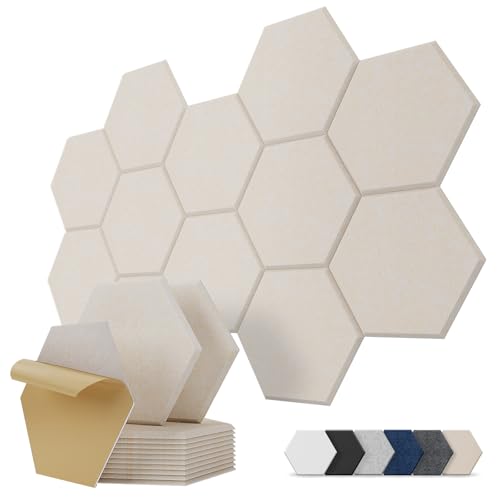
Twelve 12-by-10-inch beige polyester-felt hexagons, 0.4 inches thick with a 9.63 lb/ft3 density and peel-and-stick backing. The maker rates them for mid-to-high frequencies, roughly 600 Hz and up, and the 45-degree beveled edges tile cleanly.
The quietest-looking choice, in the visual sense. Beige hexagons melt into a neutral wall, so you get some echo control without the room announcing that it is acoustically treated, and the peel-and-stick backing keeps it renter-friendly.
*Price shown on Amazon and subject to change.
| Pick | Product | Link | |
|---|---|---|---|
| Best Wood-Slat Statement Wall | TONOR — TONOR Wood Slatwall Panels (4-Pack, 47.2 x 23.6 in, Walnut) | $98.99 | Check → |
| Best Bold, Modern Look | Art3d — Art3d 3D Fluted Wood Slat Acoustic Panels (2-Pack, Matte Black) | $79.99 | Check → |
| Best Color Statement | Dexmoko — Dexmoko Large Hexagon Acoustic Panels (Orange and Moon Grey) | $33.99 | Check → |
| Best Subtle Blend-In | Kuchoow — Kuchoow Hexagon Acoustic Wall Panels (12-Pack, Beige) | $24.58 | Check → |

Lillie Metayer
Lillie Metayer is the founder of a local program that helps apartment-dwellers take action against noise pollution. Involved in environmental activism since high school, Lillie is passionate about raising awareness of the harms of noise exposure and helping people reduce noise in their communities. In her free time, Lillie enjoys playing the violin and spending time outdoors.