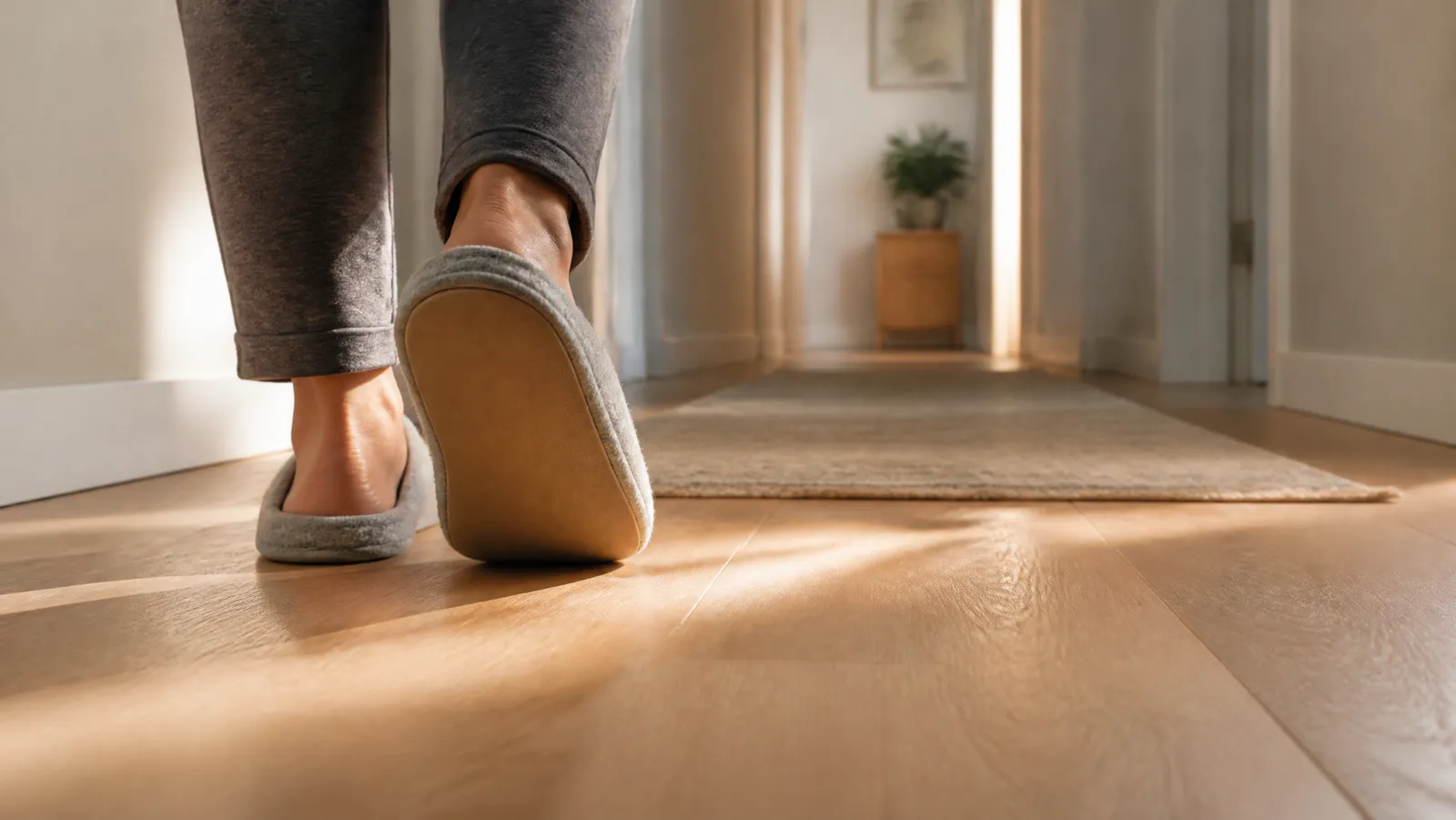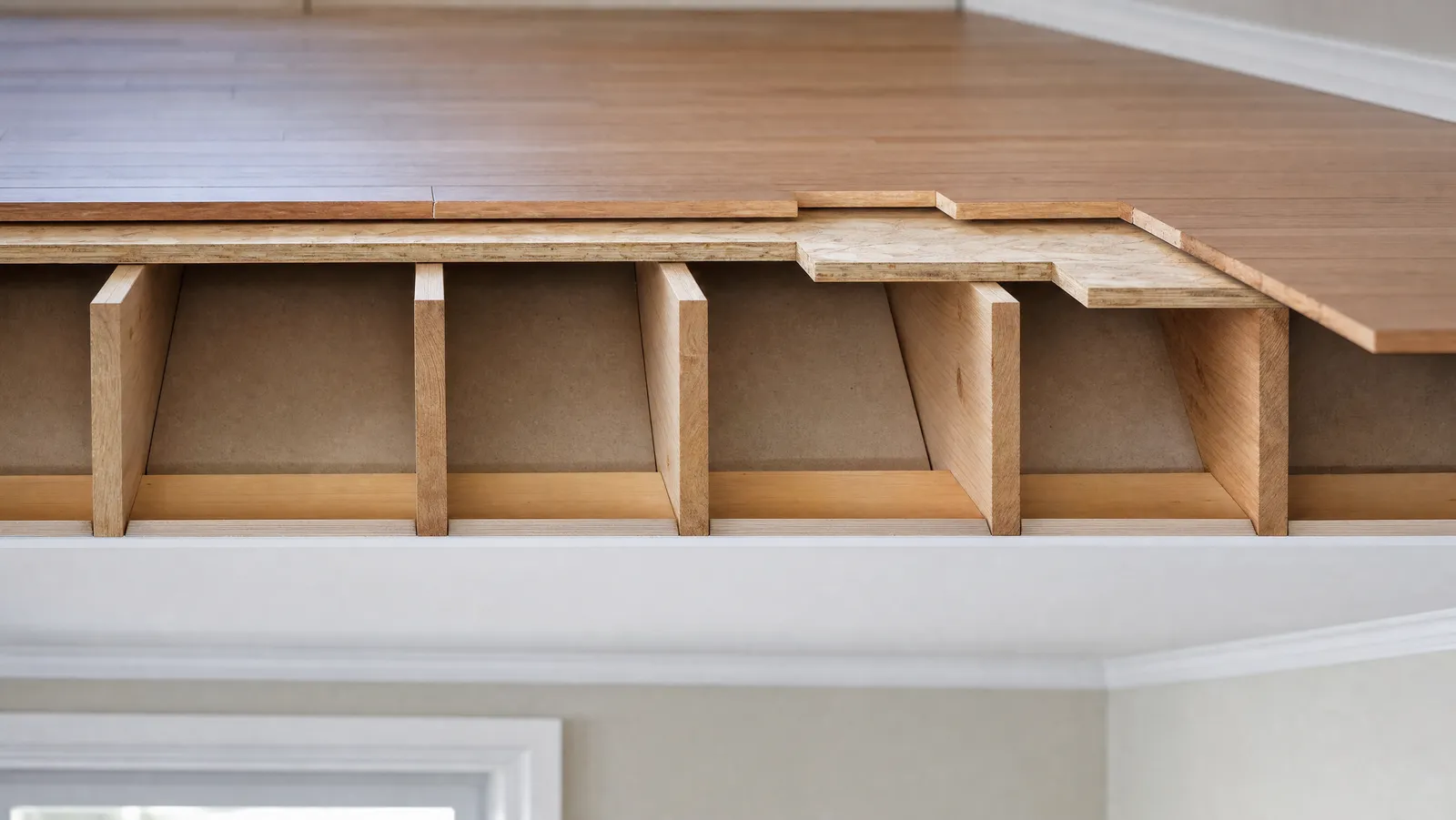
The difference is where the sound is born. Airborne noise (voices, TV, music, a barking dog) starts in the air and has to cross a barrier to reach you, so mass, sealing and decoupling stop it. Impact noise (footsteps, dropped shoes, a rolling desk chair) starts inside the building structure, and your ceiling is the thing playing it back into your room.
That one distinction explains almost every disappointing soundproofing purchase we hear about. Someone hears thumping from upstairs, buys panels or a foam kit, mounts it overhead, and gets nothing. The product wasn't a scam. It was an airborne fix applied to an impact problem, which is a bit like putting a sunshade on a leaky roof. If you're deep in this fight already, our pillar guide on how to reduce noise from upstairs neighbors has the full playbook. This article is the physics underneath it, and it's the piece that makes everything else make sense.
Impact Noise vs Airborne Noise: The 30-Second Version
Here's the honest read, compressed:
- Airborne noise travels as pressure waves through air and squeezes through any opening it can find. According to Acoustical Surfaces, airborne sound is energy that "travels through the air and then leaks through gaps, windows, doors, ducts or thin walls."
- Impact noise is mechanical. Something strikes a surface, and that surface passes the vibration into the building. Acoustical Surfaces describes impact sound as structure-borne sound, "mechanical energy traveling through joists, studs, and concrete."
- They are scored separately. Airborne performance gets an STC rating. Impact performance gets an IIC rating. A wall or floor can be good at one and bad at the other.
- Only impact noise has a source you can't reach. The energy is already in the joists before it becomes sound in your apartment.
That last point is the whole article. Everything below is elaboration.
Airborne Noise: Sound That Has to Cross Something
Airborne noise is the intuitive kind. Your neighbor's TV pushes air, the air pushes the wall, the wall pushes the air on your side, and you hear a laugh track. Because the sound has to physically cross a barrier, the barrier is where you win.
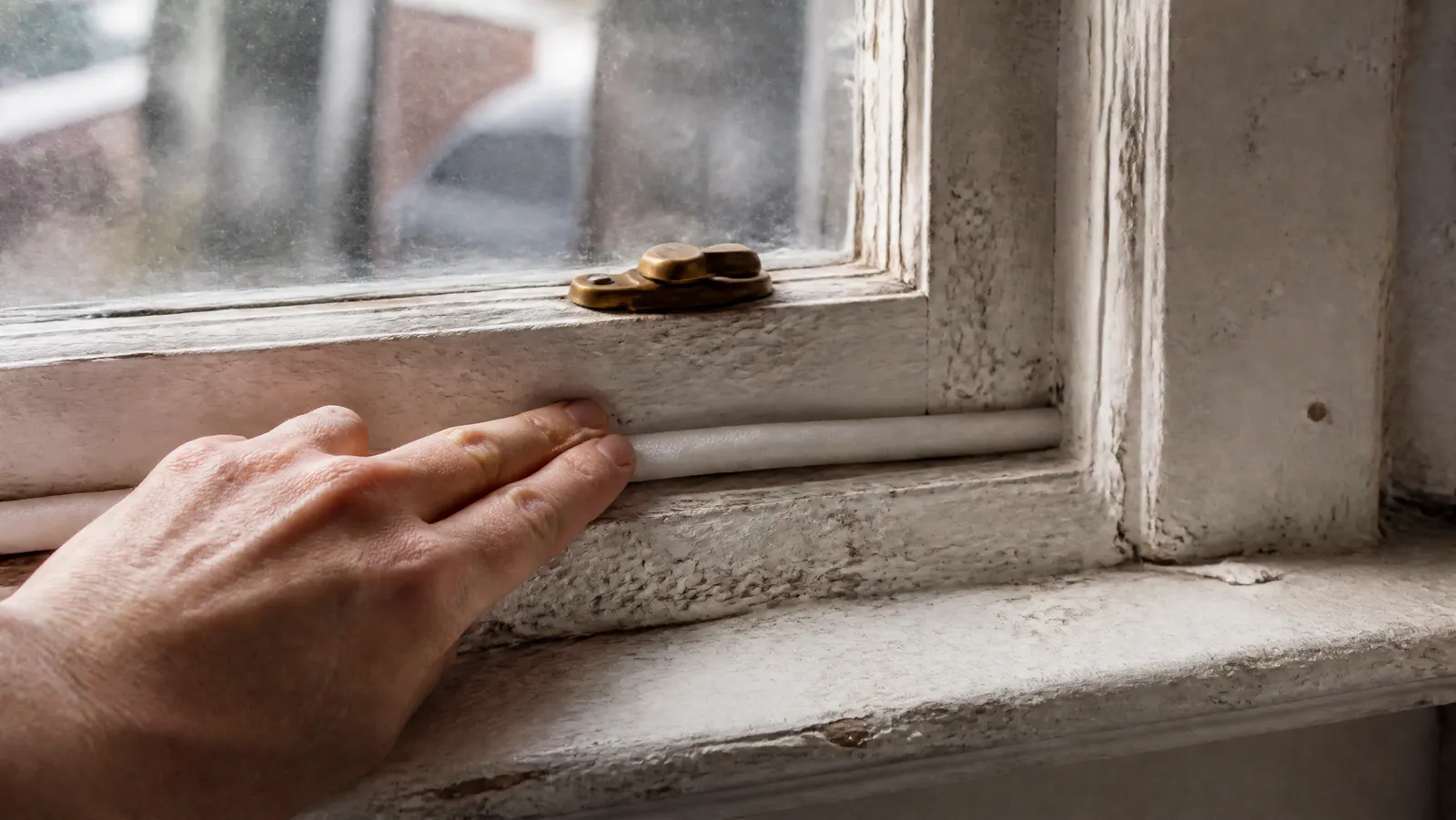
Three levers work on airborne sound, and they're the ones Acoustical Surfaces lists for it: seal the gaps, add mass, and decouple the two sides of the assembly so vibration can't bridge across. Sealing usually comes first and costs the least, because a barrier is only as good as its worst leak. Undercut doors, unsealed outlet boxes, gaps at the baseboard, and shared ductwork all leak far more sound than their size suggests.
Notice what's not on that list: absorption. Soft, fluffy material inside your room reduces echo; it does not block transmission. That's the same lesson as do acoustic foam panels block sound, and airborne-vs-impact is just the bigger, meaner version of it. Absorb and block are different jobs. Airborne and impact are different problems. Most renter frustration comes from crossing those wires.
The good news about airborne noise is that it's the one renters can genuinely improve. Sealing a door, hanging real mass on a shared wall, and killing flanking paths are all reversible, and our guide to how to soundproof apartment walls works through what's actually landlord-safe.
Impact Noise: Sound That's Already Inside the Building
Now the hard one. When a heel lands on the floor above you, no meaningful amount of that energy travels through the air of your neighbor's apartment, hits their floor, and pushes through. The heel injects energy directly into the floor structure. The joists carry it sideways and downward through the frame, your ceiling drywall is screwed to those joists, and the whole ceiling plane vibrates and radiates sound into your room like a giant, badly designed speaker cone.
That's why the usual advice fails. As IsoStore puts it, with footfall noise "the vibrations pass through the joists rather than between the joists," which is exactly why stuffing insulation into the cavity does so little; the insulation is sitting in the space the sound isn't using.
It gets worse, because footfall noise is mostly low frequency, and low frequency is the expensive end of acoustics. Research published in the Journal of the Acoustical Society of America (Blazier & DuPree, 1994) found that the peak energy in a footfall spectrum occurs at the fundamental natural frequency of the floor/ceiling system, which with typical lightweight structural framing is usually between 15 and 30 Hz — well below the range most soundproofing products are designed and rated for. The Association of Noise Consultants' 2023 report on low-frequency footfall reaches the same practical conclusion, warning that the problem "often occurs at frequencies which are even lower than 50Hz - down to 20Hz in fact" and is "most prevalent in lightweight (i.e. timber) floors due to the lack of adequate stiffness." A 2022 review in Building and Environment on structure-borne sound in multi-storey timber buildings goes further, reporting that occupants find footfall noise significantly more disturbing than other noise sources, that impact sound is more annoying in timber buildings than in concrete ones, and that existing attenuation methods are ineffective in the low-frequency range.
Read that last clause again, because it's the part the product marketing never says out loud. Professional acousticians consider this hard. You are not failing at something easy.
STC vs IIC: Two Different Scorecards
The rating systems make the split official, and knowing which is which will save you money.
STC (Sound Transmission Class) rates airborne blocking. According to Mecart, STC measures how well an assembly blocks airborne sound, tested in one-third-octave bands from 125 Hz to 4,000 Hz under ASTM E90 — a range built around the frequencies of human speech, which is why the number tracks conversation and TV so well. Mecart also spells out the catch: a system with a high STC rating "may be effective at blocking high-frequency noise, but not low-frequency noise," so a wall that scores well on paper can still feel thin against bass, subwoofers, and low-frequency mechanical noise.
IIC (Impact Insulation Class) rates impact isolation, and it's measured with a machine that literally hammers the floor. According to NGC Testing Services, the ASTM E492 test uses a standardized tapping machine on the floor of an upper lab chamber while microphones measure the sound arriving in the room below, with the IIC number derived from levels at sixteen standard one-third-octave frequencies from 100 Hz to 3,150 Hz.
Two things jump out when you line those up:
- Neither rating covers the frequencies where footfall does its worst work. STC starts at 125 Hz, the IIC test starts at 100 Hz, and the footfall research above puts peak energy at 15 to 30 Hz. A floor can post a respectable number on paper and still boom through your ceiling at 11 p.m.
- A good STC tells you nothing about footsteps. They're separate tests of separate physics. This is why "my building is STC 50, why do I hear stomping" is a completely coherent complaint.
For what it's worth, code does set a floor. Under the International Building Code, Section 1206, assemblies separating dwelling units must have an STC of at least 50 when tested to ASTM E90 (or a field-tested NNIC of at least 45 per ASTM E336), and floor-ceiling assemblies between units must have an IIC of at least 50 when tested to ASTM E492 (or a field-tested impact rating of at least 45 per ASTM E1007). Those are minimums for new construction, measured in a lab, in a building that may be older than the requirement. They are not a promise about your apartment.
If you want to play with what mass and frequency actually do to transmission, our free soundproofing calculators let you run the mass-law and loudness math yourself instead of trusting a product page.
Why Your Ceiling Is the Worst Place to Fight This
Three reasons stack against you overhead.
1. The source is on the other side of the assembly and you can't touch it. Every effective impact treatment works best at the source: something soft between the shoe and the structure. That's the floor of the apartment above, which is not yours.
2. Flanking beats surface treatments. Structure-borne energy doesn't only travel straight down through the ceiling plane. It spreads through the frame and re-radiates from the walls, so a treatment applied only to the ceiling surface gets bypassed. As IsoStore notes, resilient channel by itself provides minimal benefit for footfall noise; the isolation has to break the mechanical path, not just cover it.
3. Anything that genuinely works is construction. Decoupled ceilings on isolation clips, spring hangers, and independent ceiling frames all work by disconnecting the drywall from the joists. All of them are permanent, all of them lower your ceiling, and none of them is something a renter gets to do. We're direct about that in our guide to how to soundproof an apartment ceiling, which covers what's realistically available when you can't rebuild the assembly.
So when someone tells you they mounted panels overhead and heard no difference: correct. Absorption faces into your room, and the ceiling was never the source.
How to Tell Which One You Actually Have, Tonight
Run this in ten minutes before you spend another dollar.
- Listen for words versus thumps. If you can make out speech, laughter, or a melody, that's airborne and there's a leak path worth hunting. If it's a dull thump with no detail, that's impact.
- Watch the rhythm. Impact noise tracks a body. It starts when they get up, stops when they sit down, and travels across the ceiling in a walking pattern. Airborne noise runs continuously, at whatever volume the TV is set to.
- Touch the structure. Put a hand flat on the wall, a door frame, or a closet shelf during a loud episode. Felt vibration points to structure-borne energy. Nothing felt, but plenty heard, points to airborne.
- Close every interior door and check again. If the noise drops noticeably, you've found an airborne path (usually a door, a vent, or a hallway) and sealing will pay off. If it doesn't budge, the sound is arriving through the building itself.
- Try masking. A fan or white noise at moderate volume covers mid- and high-frequency airborne noise well. Low-frequency thumps punch straight through masking. Which one happens tells you which problem you have.
- Note the time and the frequency. Low, boomy, worse at night, no discernible words? That's a textbook impact signature.
Most renters find they have both. That's normal. Treat them separately, because the fixes don't overlap.
What the Real Fix Looks Like for Each
If it's airborne, you have real leverage and it's mostly cheap. Seal the leaks first (door bottoms, perimeter gaps, outlet boxes, shared vents), then add mass along the actual path, then decouple if you can do it without damage. Absorption inside your room is a comfort upgrade, not a barrier — buy it for echo, never for a neighbor.
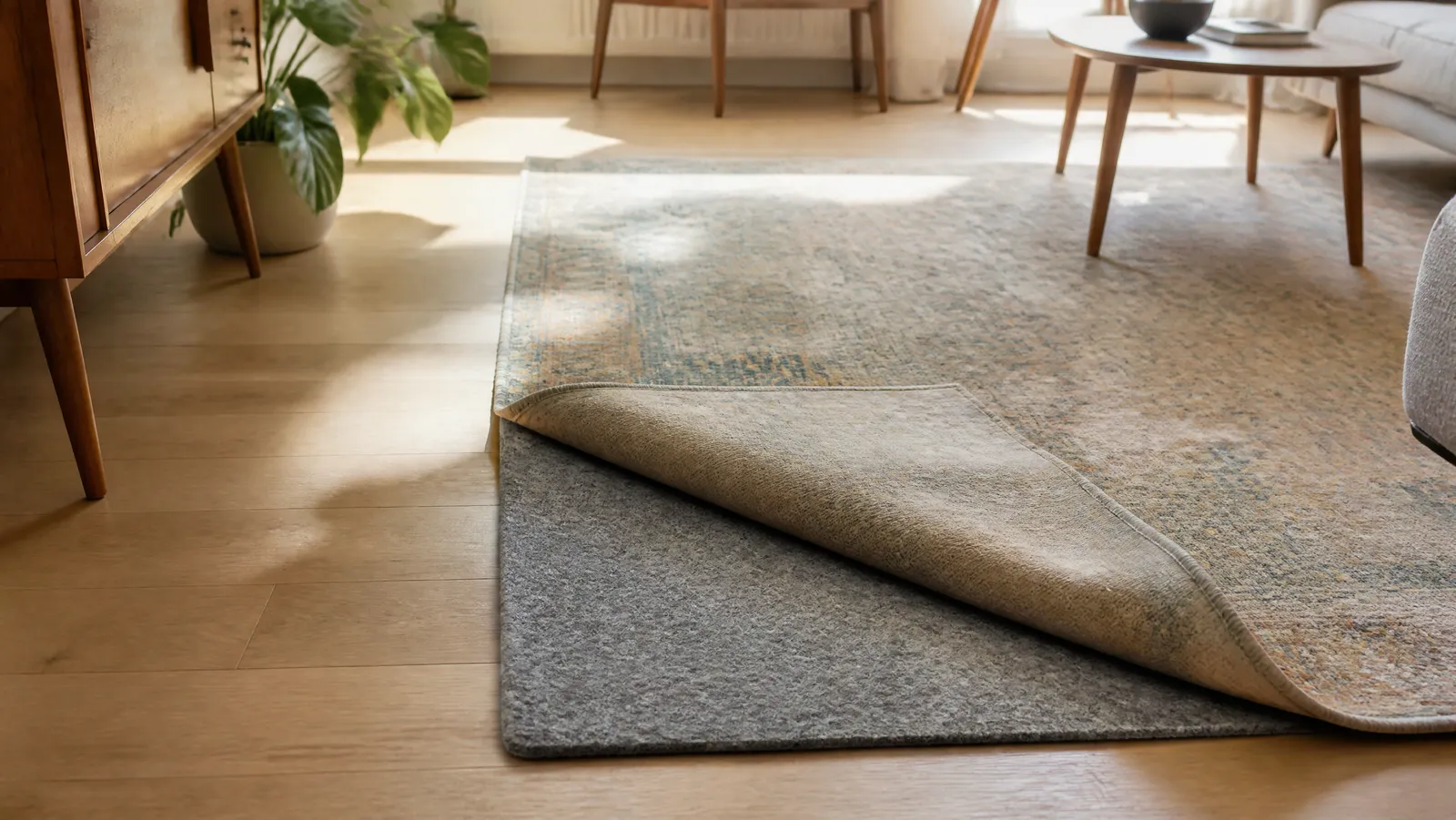
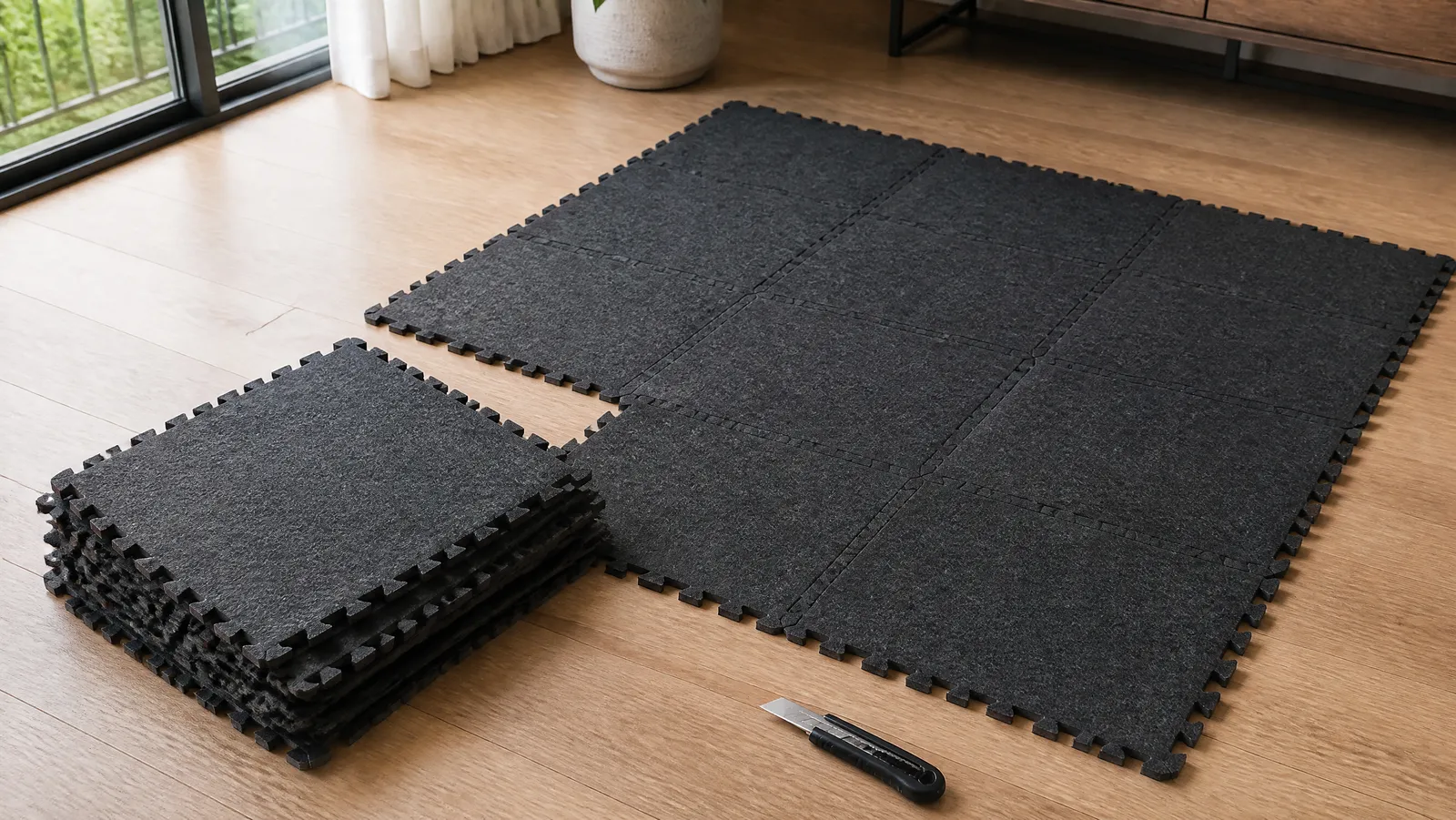
If it's impact, be honest with yourself about the physics. The single most effective intervention is soft flooring at the source, and the numbers are dramatic. According to Commercial Acoustics, a bare concrete slab lands around IIC 25 to 35, while the same slab with carpet and pad reaches IIC 65 to 75 — a difference no ceiling-side product can approach. One honest caveat: soft flooring does most of its work in the mid and high frequencies that IIC actually measures, so expect clicks, scuffs and heel taps to fade further than the deep low-frequency thump. That's why a polite, non-accusatory conversation with the neighbor about a rug and a pad in their high-traffic path, or a request to the landlord if your lease has a floor-covering clause (many do), is not a consolation prize. It is the highest-leverage move available to a renter, because it's the only one that reaches the source.
Meanwhile, protect your sleep on your side of the ceiling. This isn't giving up; it's triage while the structural problem stays structural. It matters more than people assume: the World Health Organization's Night Noise Guidelines for Europe recommend keeping night noise below 40 dB Lnight outside bedrooms, and report that above that level you start seeing self-reported sleep disturbance, environmental insomnia, and increased use of sleeping pills and sedatives. You're not being precious about a little thumping. Sleep loss is a health outcome.
The Honest Bottom Line
Airborne and impact noise are two different physical problems wearing the same word. Airborne sound has to cross a barrier, so barriers work on it. Impact sound is created inside the structure and arrives at your ceiling already converted into vibration, which is why surface treatments overhead so reliably disappoint.
Before your next purchase, ask one question: does this product change the barrier, or does it change the source? Anything you glue, hang, or lean against a surface is a barrier play. It belongs in an airborne fight. In an impact fight, it's decoration.
Diagnose first, tonight, with the listening test above. Then spend accordingly, and work through the full guide to reducing noise from upstairs neighbors for the renter-safe options that follow from whichever answer you got.

Lillie Metayer
Lillie Metayer is the founder of a local program that helps apartment-dwellers take action against noise pollution. Involved in environmental activism since high school, Lillie is passionate about raising awareness of the harms of noise exposure and helping people reduce noise in their communities. In her free time, Lillie enjoys playing the violin and spending time outdoors.