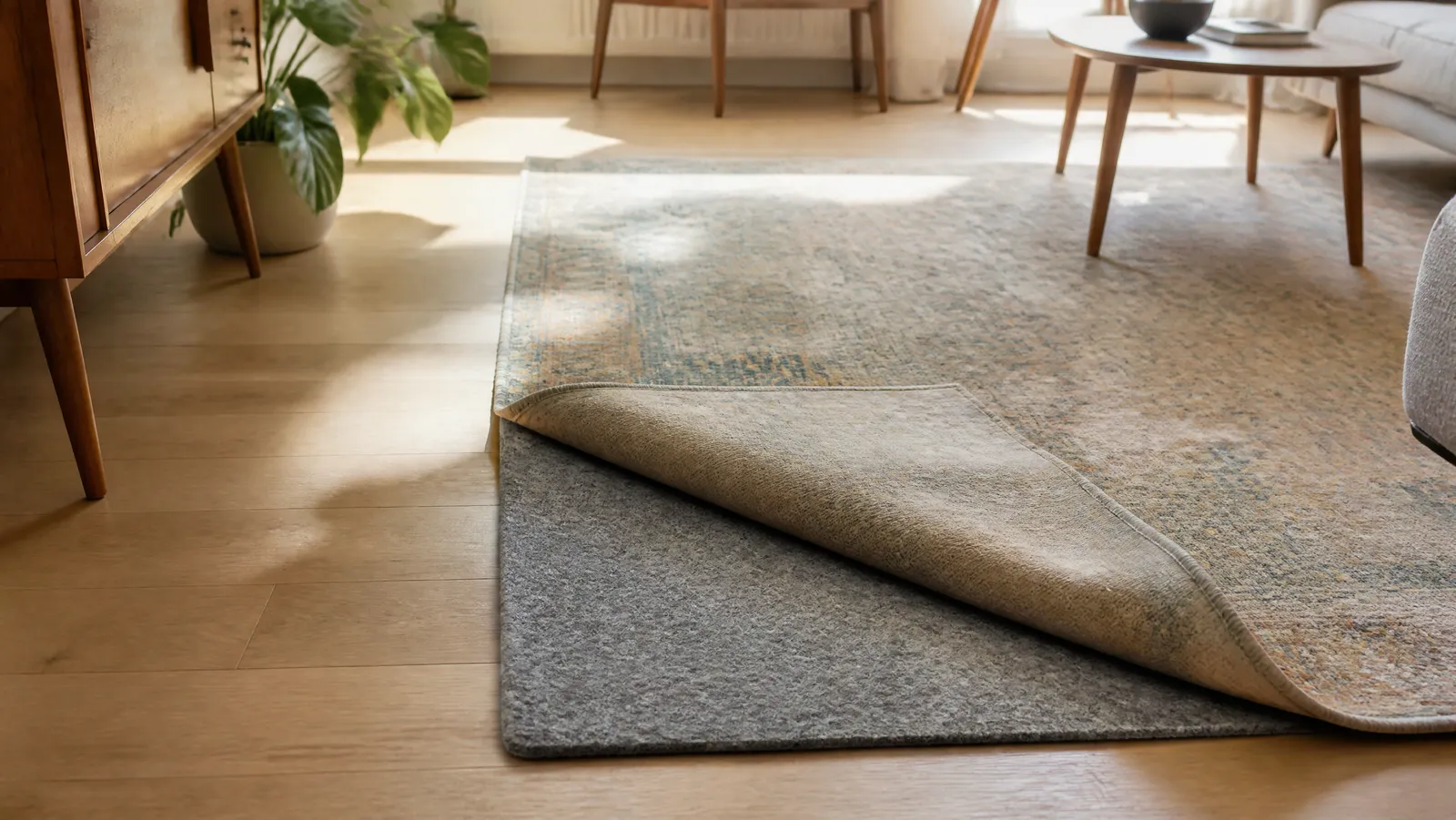
To soundproof an apartment floor, work from the top down. A thick rug over a dense pad first, then targeted mats in the two or three zones that actually generate noise, then isolation pads under anything that vibrates. Underlayment goes under a floor you install, not on top of the one you already have.
That is the whole sequence. Now the part most guides skip.
Most searches for how to soundproof an apartment floor are not about getting quieter. They are about not being the problem. You got the note under the door, or the broom handle against the ceiling at 11pm, or you simply have a downstairs neighbour and a hardwood floor and a bad feeling about the combination. This article is written for that reader.
It is the mirror image of our guide to soundproofing an apartment ceiling, which is for the person lying awake underneath you. Same floor slab, opposite side, completely different advice.
Impact noise is not airborne noise, and only one of them is your problem
Airborne noise is sound that starts in the air and has to get into the structure: voices, a television, a speaker. Impact noise starts in the structure. A heel, a dropped dumbbell, a chair leg dragged back from a table — each one injects energy straight into the floor, which is bonded to the joists or the slab, which is bonded to the ceiling below.
That is the entire distinction, and it decides everything you buy next. Anything that works by absorbing sound out of the air never gets a chance to act, because the sound you are making was never in the air on your side of the floor. It was in the building.
The building code treats these as two separate problems, in two adjacent paragraphs. According to Section 1206.2 of the International Building Code as published on UpCodes, walls and floor-ceiling assemblies separating dwelling units "shall have a sound transmission class of not less than 50 where tested in accordance with ASTM E90." Section 1206.3 then says floor-ceiling assemblies between dwelling units "shall have an impact insulation class rating of not less than 50 where tested in accordance with ASTM E492."
Two requirements. Two standards. Two different pieces of laboratory equipment. If the code writers needed separate clauses, a foam mat is not going to cover both. We go through the physics in more detail in impact noise and airborne noise are different problems.
Why treating your floor beats them treating their ceiling
Here is the good news, and it is genuinely good.
You are at the source. Impact energy has exactly one entry point into the building: the moment your heel, your chair caster or your washing machine foot touches the floor. Put something soft and resilient at that contact point and the energy never enters the structure at all.
Your downstairs neighbour has no such option. By the time the noise reaches them it is already inside the concrete and the joists, spread across the whole assembly, arriving through the ceiling and often through the walls as well. They are trying to catch something that has already gone everywhere. That is why ceiling treatments are expensive, invasive and disappointing, and why a rug over a dense pad, at a fraction of the cost, is the one move that sits directly in the impact path.
This is the one soundproofing job where the renter has the better end of the deal. A modest purchase on your side is worth more than an expensive ceiling treatment on theirs. If you want to understand exactly what they are experiencing, we wrote up what the neighbours below are actually hearing.
IIC and NRC: which number is on the box, and which one you want
This is the most important section in the article, so we will be blunt.
IIC, Impact Insulation Class, is the number that describes whether the neighbour hears your footsteps. It is defined in ASTM E989 and measured under ASTM E492 using a standardised tapping machine, with a microphone in the room below. Wikipedia's summary of the standard calls it "an integer-number rating of how well a building floor attenuates impact sounds, such as footsteps," derived "from sound attenuation values tested at sixteen standard frequencies from 100 to 3150 Hz." Higher is better. Code minimum is 50.
NRC, Noise Reduction Coefficient, is a number about echo in your own room. Wikipedia's entry defines it as "a single-number rating, rounded to the nearest 0.05, of the sound absorption coefficients of a material for the four one-third octave bands at 250 Hz, 500 Hz, 1000 Hz and 2000 Hz," measured in a reverberation room under ASTM C423. The same entry draws the line we care about: "STC relates to sound transmission loss through a construction element, while NRC relates to sound absorbed within a room by surfaces and treatments, such as to dampen echos and reverberations."
Read that once more. Absorption is about the room you are standing in. Isolation is about the room underneath. Different physical quantity, different test rig, different standard.
Now the commercial problem. Every felt floor mat we have looked at publishes an NRC, and in our experience none of them publishes an IIC. NRC is cheap and quick to test. IIC requires a full floor-ceiling assembly in a two-room lab. So the number you get shown is the one that was affordable to measure, not the one that answers your question. When a listing pairs an NRC figure with a claim that neighbours will not hear you, that is a maker conflating two different measurements, and the number does not support the claim.
One more honest caveat on IIC itself. Wikipedia notes that "real-world" footstep noise is also generated at frequencies below 100 Hz, "so the IIC value may not accurately describe the complete noise attenuation profile of a floor." That low thump through a timber-framed building is real, and the rating does not fully capture it.
The order of operations
Spend in this sequence. It is ordered by how much quiet a renter can realistically expect from each step, not by price — items three and five are among the cheapest things here.
- Soft covering, wall to wall where you can. A thick rug over a dense pad. This is the single highest-value move and it is fully reversible.
- Targeted mats in the loud zones. The three metres of walkway, under the desk chair, under the crib, under the treadmill.
- Isolate the specific offenders. Appliance feet, chair casters, speaker stands, gym equipment. Small parts, small money, often the actual fix.
- Underlayment. Only if you are genuinely laying a new floating floor, which most renters are not.
- Soft shoes and house rules. Free, and more effective than item four for most people.
Note what is not on the list: acoustic foam, soundproof paint, anything marketed for echo. Those treat the air in your room. Your problem is in the slab.
Mats, tiles and what to put on the floor
Start with the covering, because the published data on floor coverings is unambiguous and the data on everything else is thin.
Floor Expert's acoustical data tables list a bare 6-inch concrete slab at IIC 29, and the same slab with carpet directly applied at "equal to or greater than 55." The same tables show a 4.5 mm luxury vinyl tile floor on 6-inch concrete at IIC 40 without an acoustic underlayment and IIC 56 with one. Floor Expert also states that "carpet and padding, including low or medium pile, reduce the 'clacking' of impact sources on a building structure, thus significantly increasing IIC ratings, especially in wood construction."
That is a very large swing from a floor covering, and it is the reason we put the rug first every time. Note the wording though: those are ratings for tested assemblies, not for a product you unroll in a living room. A rug in your apartment is not a laboratory specimen and your building is not the reference slab.
For the pad underneath, thickness and density do the work, not branding. We keep a separate rundown of rug pads that reduce footstep noise for exactly this step. Our roundup of the best soundproof floor mats covers the harder question of what to do with the areas a rug cannot reach.
When you are the upstairs neighbor
The social part of this is not separate from the technical part. It determines which three square metres you treat.
Ask, if you can, where the noise is loudest below. Impact noise is intensely local. The neighbour does not hear your whole apartment equally; they hear the strip of floor you walk on most, and usually one or two hard-surfaced routes. Treating those beats treating a room at random by a wide margin.
Then map your own day. Walk the apartment and notice where your heel lands hardest: the entry, the kitchen run, the path from bed to bathroom. Those are your zones.
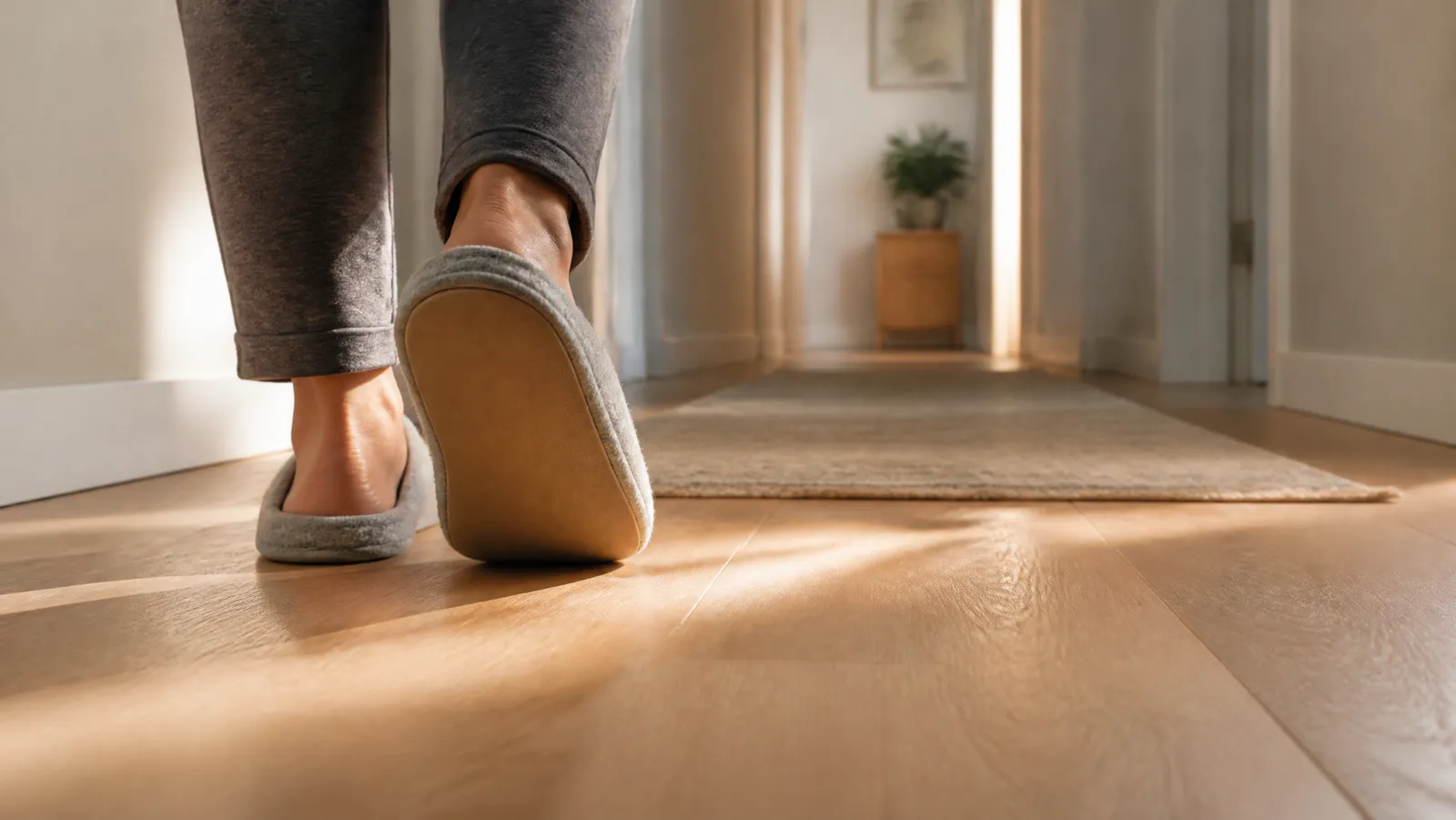
The rest of the fix is behavioural and costs nothing. Indoor shoes or slippers instead of hard soles. Felt pads under every chair and table leg. Cupboards and drawers closed rather than let go. Nothing heavy set down on a hard floor after ten at night. If you want to stop your footsteps bothering the downstairs neighbors, that short list plus one good rug is most of the achievable result, and we go deeper on it in its own article.
Do floor mats actually work?
When renters ask do soundproof floor mats actually work, the honest answer splits in two: yes for some jobs, no for the job most people buy them for.
A resilient mat under a specific impact source works, because it sits exactly in the contact path and the energy has to pass through it. A mat scattered around a room as decoration does very little, because footsteps land on the floor beside it.
The felt and foam mats sold in this category are mostly studio products. Read the listings and you find drum kits, pianos, monitor speakers and home gyms. TroyStudio markets its mats for drums, piano, speakers, treadmill, home gym and playroom, which is an accurate description of where they earn their money. They were designed to stop a drummer's room from ringing and to take the edge off a kick drum into the floor, not to make a two-bedroom apartment inaudible from below.
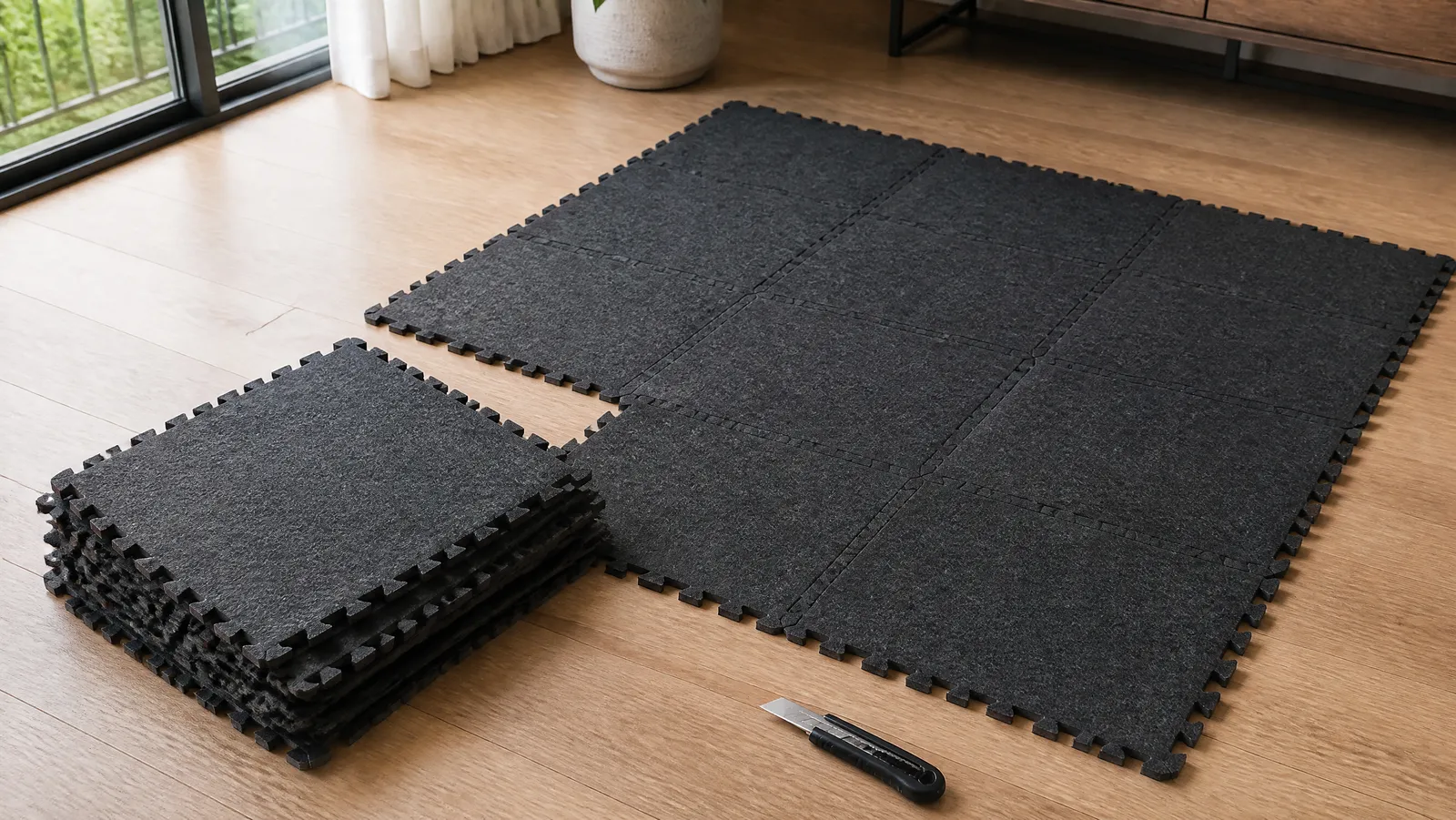
So buy them as zone treatment. Under a desk chair. Under a drum throne. Under a treadmill deck. Under the crib and the changing table. Cut to fit the entry hall walkway. In those roles, the 0.32 inch felt of the TroyStudio interlocking acoustic floor mats at about $47 as of September 2026 is a sensible, cuttable, removable layer.
What we will not tell you is how many decibels it saves the apartment below, because nobody has measured that and the maker does not publish it. For the underlying reason a felt panel cannot do the same job as a floating floor, see again impact noise and airborne noise are different problems.
Underlayment: what goes under the floor
Underlayment is the real engineering answer to impact noise, and for most renters it is not actionable. It is a resilient sheet laid on the subfloor before a floating floor goes down, so the walking surface never touches the structure directly.
The industry even has a metric for exactly this layer. Commercial Acoustics describes delta IIC as a measure of "how many impact-isolation points a single underlayment or floor covering adds on its own," found by testing "a bare 6-inch concrete reference slab" alone and then with the underlayment, and taking the difference. Their published bands run from delta IIC under 18 for minimal isolation, through 18 to 21 for moderate, 22 to 25 for what they call "the spec sweet spot," and 26 or more for premium.
Their material ranges are worth knowing, because they show how much thickness matters: 2 mm closed-cell polyethylene foam at delta IIC 15 to 18, a 3 mm recycled fibre or felt mat at 16 to 20, 3 mm natural cork at 18 to 21, 6 mm cork at 20 to 23, 5 mm recycled rubber at 21 to 25, and 10 mm recycled rubber at 25 to 29.
If you are actually laying LVP or laminate — in a rental you own the improvements to, or with a landlord who has agreed in writing — the HOLNURY 3-in-1 underlayment roll covers 200 square feet at about $65 as of September 2026, in 3 mm EVA with a foil vapour barrier and pre-attached lip tape. HOLNURY states an STC of 72 and an IIC of 73 for it. Treat those as ratings for a complete tested floor-and-ceiling assembly rather than as properties of the roll itself, because a 3 mm sheet has no IIC on its own — IIC is a property of an assembly, by definition.
If you are not laying a floor, skip this entirely. An underlayment placed on top of a finished floor is just an expensive mat. Our dedicated piece on acoustic floor underlayment will take this apart in more detail when it publishes.
What a renter simply cannot do
Worth naming the options so you can stop reading about them:
- A floating floor on battens or isolators. The genuine fix. It is a construction project, it raises the floor height, and it does not come back up at move-out.
- Resilient channel or isolation clips. Those go on the ceiling below, in the neighbour's apartment, inside their drywall. Not yours to touch.
- Subfloor work. Adding mass or a damping layer under the finished floor means lifting the finished floor.
- Glue-down acoustic assemblies. Permanent by design. Your deposit pays for the removal.
None of these survive a lease, and any contractor quoting them to a renter is quoting the wrong person. If the noise is travelling the other way and you are the one being kept awake, our guide to soundproofing an apartment ceiling covers what is left once these are off the table.
Rugs, mats or underlayment?
Short version, in the order we would spend:
- Rug plus dense pad. Best coverage per dollar, reversible, no tools. The Floor Expert figures above put carpet on concrete at a far higher assembly IIC than bare slab, and a thick rug over a felt or rubber pad is the closest thing a renter has to that. Start here.
- Mats. Best for a defined zone with a known offender. Cuttable, liftable, cheap enough to get wrong. Useless as decoration.
- Underlayment. Best acoustic performance per millimetre, and only available if the floor is coming up. Not a renter product.
The pad matters more than people expect. A thin foam pad under a heavy rug mostly stops the rug sliding; a dense pad with real thickness is the resilient layer doing the acoustic work, which is why we treat rug pads that reduce footstep noise as a purchase in its own right rather than an accessory. We will publish a full breakdown of rugs, mats and underlayment compared, with the trade-offs laid side by side.
Home gyms, treadmills and dropped weights
This is the highest-risk activity in an apartment and the one most likely to end in a complaint or a lease conversation.
Dropped weights are in a different category from footsteps. A dumbbell hitting a floor delivers a large amount of energy in a few milliseconds, most of it at low frequency, and low frequency is precisely where the standard impact rating stops measuring. Nothing you can buy at a reasonable price will make a dropped barbell acceptable in a wood-framed building. Do not drop weights in an apartment. Set them down.
For the rest of it, the approach is layered and works reasonably well:
- A dense mat under the equipment footprint, not under the whole room.
- Rubber or cork isolation pads under each treadmill or rack foot, so the frame does not touch the floor directly.
- Rubber gym tiles over the top for the weights that will inevitably be set down hard.
- Equipment positioned over a load-bearing wall line rather than the middle of a span, where deflection is greatest.
Treadmills in particular are a vibration problem rather than a footstep problem, which is why they respond to isolation under the feet. We are writing a full guide to running a quiet home gym in an apartment, because the details differ enough from general floor work to deserve their own piece.
Appliances that shake the building
If the complaint arrives at a specific time of day, look at your appliances before you buy a single rug.
A washing machine on spin is the usual suspect. Second Skin Audio describes a loud washing machine as producing two distinct kinds of noise: vibration that travels mechanically through the floor and structure, and airborne sound spreading into nearby rooms. The first one is what reaches the neighbour, and it enters the building through four small feet.
That is a very small contact area to treat, which is what makes it the best value fix in this whole article. The PneumaticPlus rubber and cork anti-vibration pads are $16.50 as of September 2026 for four pads at 4 by 4 inches and 7/8 inch thick, rated to 50 PSI maximum load, with alternating rib heights so they still deflect under lighter equipment. The maker lists air compressors, HVAC, stereo equipment and treadmills among its applications.
Before you buy anything, do the free steps. Level the machine so all four feet carry weight, check that the shipping bolts were removed, and stop overloading the drum, since an unbalanced load is what turns a spin cycle into a hammer. Then add the pads. Our separate article on washing machine vibration noise will cover the diagnostic sequence properly.
The same logic applies to anything else with a motor or a subwoofer: an air purifier on a hard floor, a mini fridge, a speaker cabinet sitting directly on floorboards. Break the contact.
Interlocking tiles and foam puzzle mats
Puzzle mats are the default suggestion in every apartment forum, and they deserve a more careful answer than they usually get.
What they are good at: covering an awkward area cheaply, coming up in one evening, and taking the sharp top edge off an impact. They are easy to cut, they do not need adhesive, and a renter can reconfigure them as the furniture moves.
What they are not: rated. No interlocking tile we have seen publishes an impact insulation figure, and the absorption figures that do get published describe the room you are standing in. Remember the delta IIC ranges above, where 2 mm closed-cell foam sits at the bottom of the scale on Commercial Acoustics' bands. Thin foam is not a high-performing acoustic layer even when it is installed the way it was designed to be, under a floating floor.
The practical compromise is thickness and coverage. A thicker, denser tile over the zone that actually generates noise, with a rug on top if you can stand the look, is a real improvement over a hard floor. A quarter-inch of open-cell foam scattered around a living room is not. We will publish a closer look at interlocking foam tiles, including what the density numbers on the listings do and do not tell you.
Pets, kids and hard floors
Two of the most common complaints, and both respond to targeted work rather than whole-room treatment.
Dogs generate two separate noises on a hard floor, and both of them are impact noise: the click of nails, and the thud of a running or jumping animal. The clicking is the one owners underestimate. Busy Pet Parent calls claws on hard flooring "the top complaint from downstairs neighbors" and notes that on hardwood and tile "every footstep, claw click, and toy knock resonates to the apartment below." Runner rugs along the dog's habitual route are the fix for both. Keeping nails trimmed reduces the clicking at the source.
Children run in loops, and those loops are remarkably consistent — bedroom to sofa, sofa to kitchen. Put the coverage on the loop. A large rug with a dense pad in the main play area plus a runner on the corridor does more than a mat in every room.
Furniture matters too. Felt pads under every chair leg, and soft casters instead of hard ones on desk chairs, remove a whole category of scraping noise for a few dollars. A guide to dog nails and running kids on hard floors is on our list, because this is where most real apartment disputes actually start.
What your lease actually allows
Check before you buy, because the constraint is usually the adhesive, not the product.
- Nothing that nails, screws, glues or staples. That rules out tack strips, glue-down tiles and most permanent underlayment installs.
- Watch adhesive tape on finished wood. Removable tape is still tape. Test it in a closet corner and leave it a week before you commit to a room.
- Do not change floor height at doorways. A layer thick enough to stop a door swinging is a layer you will be removing at move-out.
- Carpet-coverage clauses are common. Older buildings, co-ops especially, often carry a house rule requiring rugs over a stated share of the floor area. Read your own lease and house rules rather than taking a number from us.
- Get written permission for anything structural. If your landlord agrees to a new floating floor, that agreement belongs in an email, not a conversation.
One more thing worth doing early: if a neighbour has complained, respond in writing and say what you are changing. A documented good-faith effort is worth a great deal if the dispute escalates to the building. We will cover what your lease lets you do to the floor in detail in its own article.
The bottom line
- You have the better half of this problem. Treating impact noise at the source is cheaper and more effective than treating it at the receiving ceiling. Your rug and pad beat their expensive ceiling.
- Impact is not airborne. The building code separates them into Sections 1206.2 and 1206.3 with different ASTM test methods, per UpCodes. Absorption products cannot touch impact noise.
- IIC is the number you want; NRC is the number you get shown. IIC is tested under ASTM E492 across sixteen bands from 100 to 3150 Hz; NRC is an ASTM C423 absorption average over four bands. Mat makers publish NRC because it is far cheaper to test.
- Floor covering is the biggest lever a renter has. Floor Expert lists bare 6-inch concrete at IIC 29 and the same slab with carpet at 55 or better.
- Mats are zone tools. They are studio products in origin. Use them under the specific thing making the noise.
- Underlayment is for people laying floors, and its published delta IIC figures, per Commercial Acoustics, describe a lab slab rather than your apartment.
- Appliance feet are the cheapest win in the building. Four small pads, one contact path, an immediate difference to a specific complaint.
Rug and pad first. Zones second. Isolate the offenders third. Skip everything sold for echo, and never buy an NRC number expecting it to travel downstairs.
Explore the full series
- The Best Soundproof Floor Mats for Apartments — Felt tiles, what their NRC numbers really mean, and where a targeted mat beats wall-to-wall.
- How to Stop Your Footsteps Bothering the Downstairs Neighbors — The free fixes first, because shoes and chair casters beat anything you can buy.

Twenty-four panels of 100 percent polyester fibre felt, each 11 by 11 inches and 0.32 inches thick, at a maker-stated density of 135 kg/m3 (8.4 lb/ft3) and 0.17 lbs per panel. The box includes 36 pieces of removable double-sided tape, and the panels cut with a utility knife.
TroyStudio states an NRC of 0.7 and an average absorption coefficient of 0.75. Those are absorption numbers, which describe echo inside your own room rather than what the apartment below hears, and no maker in this category publishes an impact rating. Buy this as a cuttable pad for the one zone that generates the noise, such as under a drum stool, a desk chair or a treadmill, and not as wall-to-wall impact isolation.
*Price shown on Amazon and subject to change.

A 200 square foot roll of 3 mm EVA with a silver foil vapour barrier and pre-attached lip tape, sold for hardwood, laminate and other floating floors, and combining sound insulation, moisture barrier and thermal insulation in one layer.
The only product here that sits in the actual impact path, and the only one most renters cannot use, because it goes underneath a floor you are installing rather than on top of the one you already have. HOLNURY states a Sound Transmission Class of 72 and an Impact Isolation Class of 73. Read those as assembly ratings for a complete tested floor and ceiling, not as properties of a 3 mm roll on its own.
*Price shown on Amazon and subject to change.
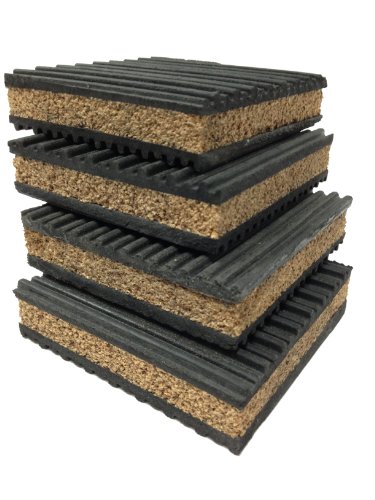
Four rubber and cork pads, each 4 by 4 inches and 7/8 inch thick, rated by the maker to a 50 PSI maximum load, with alternating rib heights so they compress usefully under both light and heavy loads.
The cheapest item in this guide and the one most likely to settle a specific complaint, because appliance vibration enters the building through four small feet and nowhere else. PneumaticPlus lists air compressors, HVAC equipment, stereo gear and treadmills as applications, and publishes no decibel or impact rating, so treat these as decoupling hardware rather than a rated acoustic product.
*Price shown on Amazon and subject to change.
| Pick | Product | Link | |
|---|---|---|---|
| Our Pick | TroyStudio — TroyStudio Interlocking Acoustic Floor Mats (24 pcs, 11 x 11 x 0.32 in) | $46.99 | Check → |
| Best If You're Laying New Floor | HOLNURY — HOLNURY 3-in-1 Acoustic Floor Underlayment (200 sq ft roll, 3 mm EVA) | $64.99 | Check → |
| Best for Appliance Feet | PneumaticPlus — PneumaticPlus Rubber/Cork Anti-Vibration Pads (4 pack, 4 x 4 x 7/8 in) | $16.50 | Check → |

Lillie Metayer
Lillie Metayer is the founder of a local program that helps apartment-dwellers take action against noise pollution. Involved in environmental activism since high school, Lillie is passionate about raising awareness of the harms of noise exposure and helping people reduce noise in their communities. In her free time, Lillie enjoys playing the violin and spending time outdoors.