Let's be honest about what actually blocks sound through a wall, because two techniques genuinely do it and most of the internet muddles them. Green glue soundproofing means damping — a viscoelastic compound spread between two layers of drywall that turns sound into a trace of heat. Decoupling means physically separating the two sides of a wall so vibration can't cross the framing. Both work. Both are construction, which is the catch for renters.
If you rent, that last word — construction — is the whole story. Green Glue and decoupling live inside the wall, between drywall layers or behind the studs, so installing them means opening or building a wall and then closing it back up. That is not a reversible upgrade you undo before a walk-through. This piece explains how each one works, why they beat simply piling on mass (especially against bass), and what a renter should reach for instead. For the wider playbook, start with our complete guide to soundproofing apartment walls.
How Does Green Glue Work?
Green Glue is not glue in the way the name suggests, and it is not a barrier either. It is a viscoelastic damping compound — a thick, slightly gooey layer you spread across one sheet of drywall before screwing a second sheet over it. Sandwiched between two rigid panels, it does its job through what acousticians call constrained layer damping.
Here is the mechanism. According to Acoustical Surfaces, when sound hits the wall the two drywall panels try to vibrate, and the soft compound trapped between them is forced to shear — stretching and sliding — which converts that vibrational energy into a tiny amount of heat. The often-repeated analogy is rubbing your hands together: the drywall is the backs of your hands, the Green Glue is the friction surface, and the warmth is sound energy being spent instead of passed along. Damping does not stop sound by sheer weight; it drains the vibration's energy.
Two details set expectations. First, it only works constrained — Green Glue has to be sandwiched between two hard, dense layers, so a single tube smeared on a bare wall does nothing. According to TMSoundproofing, despite the brand name the compound is not a structural adhesive, and you still screw the drywall through it into the studs. Second, the payoff is real but bounded. According to Second Skin Audio, a wall treated with Green Glue between drywall layers gained about 10 STC points over an untreated reference wall in comparison testing — a meaningful jump, but one that assumes you added a whole second layer of drywall with the compound in between.
What Decoupling Does: Resilient Channel and Isolation Clips
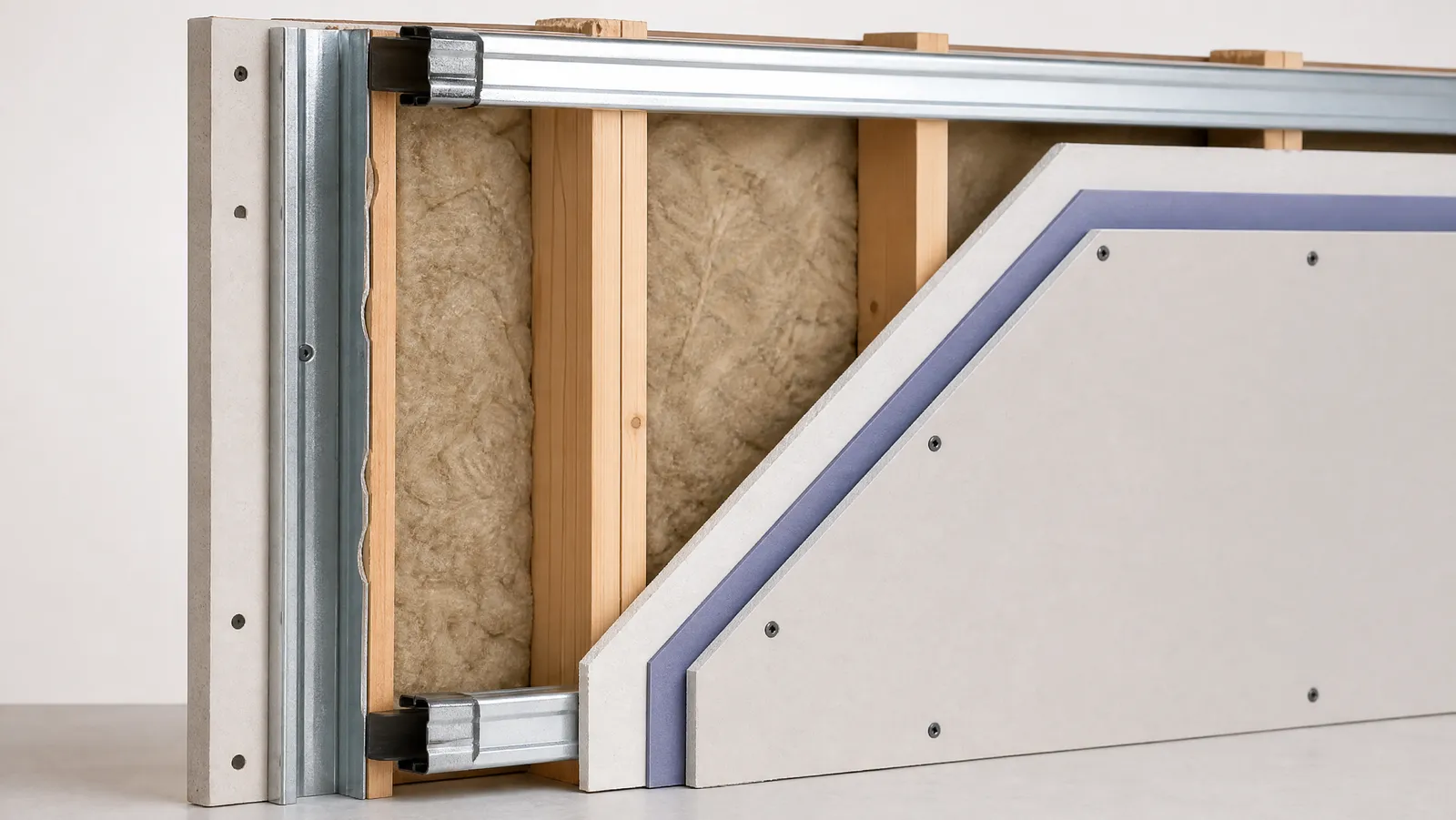
Damping tackles vibration inside the drywall. Decoupling tackles the other path — vibration traveling through the studs. When drywall is screwed straight to the framing, a sound that shakes one side of the wall passes into the studs and re-radiates out the other side as if the two rooms were mechanically joined. Decoupling breaks that bridge.
The two common ways to do it both sit behind the drywall. Resilient channel is a thin, springy metal strip screwed across the studs; the drywall mounts to the channel, not the studs, so the channel flexes and soaks up vibration instead of transmitting it. Isolation clips go further — rubber-isolated clips hold a metal hat channel, creating a genuinely floating layer of drywall. According to Second Skin Audio, both approaches decouple the drywall from the framing so structure-borne noise can't pass straight through and re-radiate into the next room.
The numbers show why builders bother. According to AI Home Building, a standard interior wall — one layer of drywall on each side of the studs — rates only about STC 33, where normal speech is clearly audible next door; mounting the new drywall on resilient channel instead of directly to the studs lifts it to roughly STC 44 to 46, where loud speech is audible but no longer intelligible. Clips do even better. According to Second Skin Audio, independent clip-and-channel assemblies consistently add 8 to 20 STC points over standard construction, taking a wall from the mid-30s into the STC 50-55 range. That is the difference between hearing every word and forgetting the neighbor is home.
Green Glue vs Mass Loaded Vinyl: Three Different Jobs
This is where people get tangled, so let's separate the tools by the job each one actually does. There are three levers for blocking sound, and they are not interchangeable:
- Mass resists sound by sheer weight. Mass loaded vinyl for apartment walls is the classic add-mass product — a dense, limp sheet you hang to make a surface heavier.
- Damping drains vibration as heat. That is Green Glue's entire trick.
- Decoupling removes the structural path. That is resilient channel and clips.
So the "green glue vs mass loaded vinyl" question is a bit of a category error — they solve different halves of the problem, and a serious wall uses more than one. But if you force a head-to-head, damping tends to win where mass struggles. According to Second Skin Audio, in comparison tests Green Glue delivered roughly a 4-point STC edge over walls treated with MLV, and pulled ahead most at low frequencies, where it outperformed MLV by roughly 10 dB in the bass region. Mass and damping are complementary, not rivals; the reason Green Glue looks better in that test is that it attacks resonance, which is exactly where added mass runs out of road.
One thing none of these three is: an absorber. If you are wondering where acoustic foam fits into this comparison, it doesn't — foam softens echo inside a room and does essentially nothing at a shared wall. If that is news, read whether acoustic foam blocks sound before spending a cent, because foam is not on the blocking side of this ledger at all.
Why Bass Is the Hard Case
Every technique above earns its keep against a specific enemy: low frequencies. Bass is the sound that ignores cheap fixes, and understanding why explains the whole hierarchy.
Adding weight follows the mass law. According to ACT Acoustics, a single-panel wall's sound transmission loss rises by about 6 dB for every doubling of its mass — in the real world closer to 5 dB — but that rule works best at higher frequencies and weakens as the pitch drops. Down in the bass region, stiffness and resonance take over from mass, which is why the same wall that muffles conversation lets a subwoofer through. You cannot simply out-mass a bassline; doubling the drywall again and again gives you steadily less for your money exactly where you need it most.
That is precisely why damping and decoupling matter. Green Glue targets the resonance mass can't, and decoupling removes the structural path that carries low-frequency thumps best. It is no coincidence that Green Glue's biggest measured advantage over pure mass showed up at the low end. If bass is your problem — footsteps, a home theater, a car-stereo bassline — no amount of a single material solves it, and that is a physics limit, not a shopping problem.
The Renter Catch: Why You Usually Can't Do This
Here is the blunt part. Everything that makes Green Glue and decoupling effective also puts them out of reach for most renters, because all of it lives inside the wall.
Green Glue only works sandwiched between two layers of drywall, so using it means either hanging a second layer of drywall over your existing wall or opening the wall up — then taping, mudding, and painting. Decoupling is harder still: resilient channel and isolation clips mount to the studs behind the drywall, so you cannot add them without stripping the wall to the framing and rebuilding it. These are construction projects, not reversible upgrades. There is no version you quietly undo the week before your move-out inspection.
That collides with two rental realities. You usually can't structurally alter the unit without written permission, and even if you could, you would be paying to build something you leave behind — and likely to demolish and restore it, or forfeit the deposit. This is the same trap that makes other "just add a layer" shortcuts a bad deal for renters. It is worth knowing which promised fixes are real physics and which are marketing, which is exactly the question we work through in does soundproof paint work. Green Glue is real; it is just real construction.
What Renters Should Do Instead
You can't damp or decouple a wall you're not allowed to rebuild — but you're not out of options, you just work on the surface instead of inside the structure. The renter version of this playbook leans on the one lever you can pull without construction: reversible mass, plus airtight sealing.
- Seal the leaks first. Sound pours through the gaps around outlet boxes, along the baseboard, and at the wall edges. A bead of removable acoustic caulk on those paths is cheap, comes with no demolition, and often does more than any surface product.
- Add mass you can take with you. Heavy curtains against the wall, a floor-to-ceiling bookshelf packed with books, layered moving blankets — none of them screw into studs, and all of them put real weight in the sound path. It is a fraction of what a built assembly does, but it is honest, no-damage weight.
- Keep expectations calibrated. Surface fixes nudge; they don't transform. If a neighbor's bass is coming through the structure, no renter-legal fix fully stops it, and any product promising otherwise is overselling.
The theme is the same one that runs through this whole site: match the tool to your situation, and don't pay construction prices for a result you're not allowed to build.
The Bottom Line
Green Glue and decoupling are the real deal — the two techniques that genuinely reduce sound transmission rather than just softening echo. Green Glue damps, draining vibration as heat between two layers of drywall; decoupling isolates, cutting the structural path with resilient channel or isolation clips. Both beat simply piling on mass, especially against the bass that defeats everything else. And both are construction, which is why most renters, honestly, can't use them.
If you own your place or have a landlord's blessing to build, they are worth every dollar. If you rent, put your money into sealing gaps and adding reversible mass, and hold your expectations to what the surface can actually do. Either way, the point is to spend where the physics pays you back — which is exactly what our complete guide to soundproofing your apartment walls is built to help you do.

Lillie Metayer
Lillie Metayer is the founder of a local program that helps apartment-dwellers take action against noise pollution. Involved in environmental activism since high school, Lillie is passionate about raising awareness of the harms of noise exposure and helping people reduce noise in their communities. In her free time, Lillie enjoys playing the violin and spending time outdoors.